Our history
1987
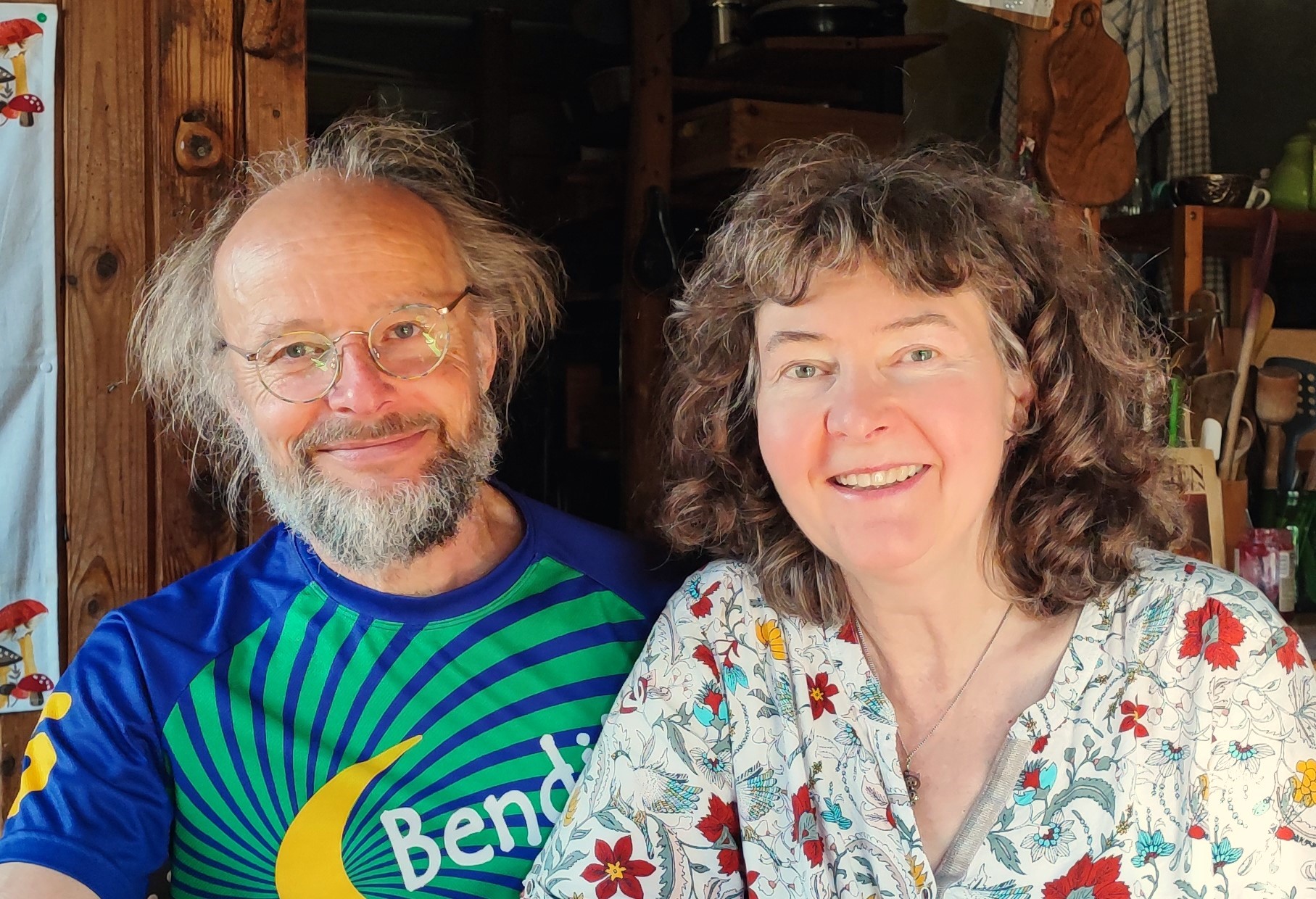
Thomas and Claudia meet at the beginning of July 1987, at the end of the summer semester at the University of Zurich.
They spend the first two months of the semester break,hundreds and usually thousands of kilometres away from each other – only through a few letters they remain in friendly contact over the long distances.
It wasn’t until Thomas returned from South Africa at the beginning of September, that they arranged to meet again…. and again and again…… and in this way, many exciting conversations and ever-increasing heart sparks quickly turn into an intense, creative and passionate energy connection on all levels. After three weeks of increasingly varied and regular being together, they both feel as if they have known each other forever and have the certainty that they are destined for each other in this life.
On 7 October, at a place of power at the top of the mountain, they commit to each other to go through life together with love and respect for each other for as long as it is given to them in this earthly life. To overcome together the challenges that will arise from the connection of their energies in life.
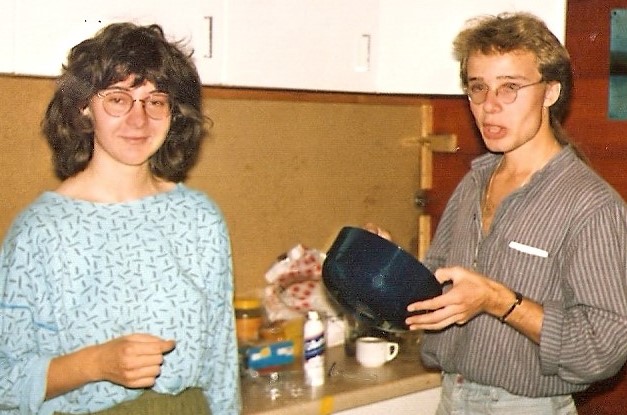
Shortly afterwards, Thomas has one last commitment as camp cook at an autumn camp for girlscouts. Claudia accompanies him as his wife and assistant chef. This is their first project together.
After that, the next academic year begins. Claudia continues her studies as normal, Thomas switches from Philosophy to the brand new Environmental Sciences programme at ETH Zurich.
They regularly alternate between living with Claudia’s parents and then back with Thomas’s parents. But the desire for a small flat and financial independence is growing stronger and more mature every day.
1988
We’re now living together. Thomas at some point leaves university and finds a job at the post office in Zurich as a postman. Financial independence, civil marriage. We move into our first housing-cooperative apartment in Zurich’s 4th district. Claudia, who has now also left her studies, gives birth to our first daughter, Lisa.
1989
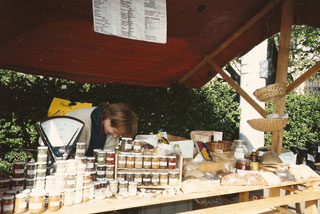
We begin our own business with a market-stand selling spices, herbs, tea, dried fruits, nuts, oils and other natural, mostly organic products. At this time we also take our first small steps towards creating an experimental community.
1990
Birth of a second daughter, Nadja. In Zurich Thomas meets Thomas Banyacya and listens to the Hopi Indian prophecies.
Speech by Thomas Banyacya before the UN (DE)
Remembering Thomas Banyacya (EN)
Our decision to leave the city and “normal” modern life.
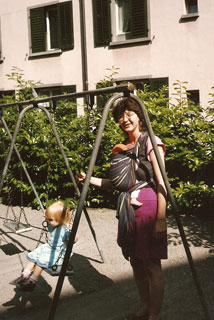
1991
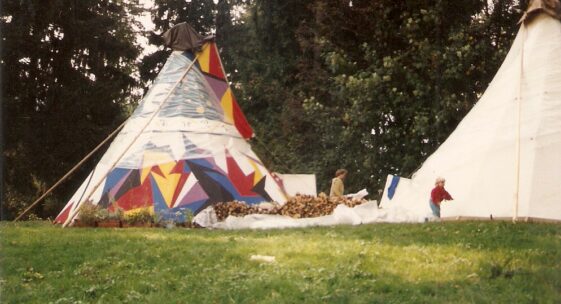
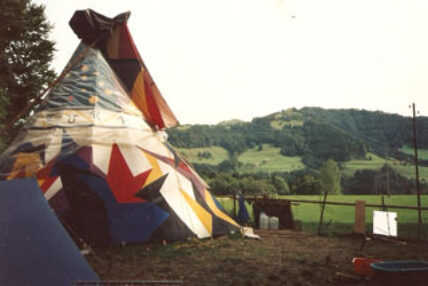
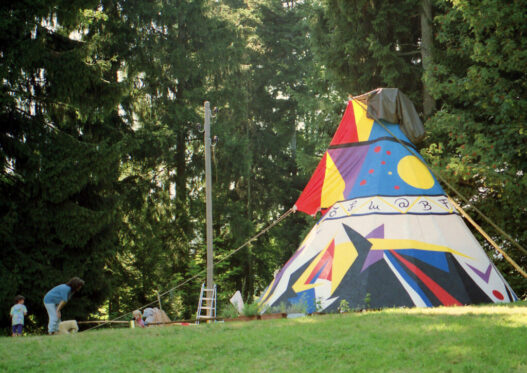
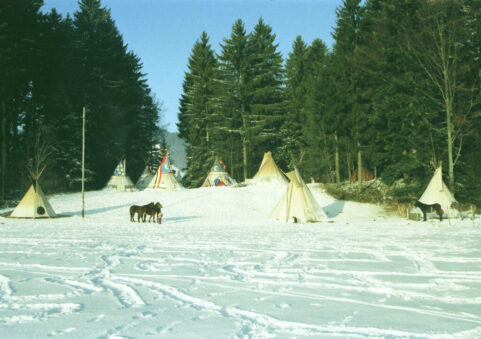
Our first, more moderate attempts to “drop out” from civilisation turn out not financially workable. A sudden inspiration gives us the idea to live in a tepee, and we take the radical decision to manufacture one, give notice on the apartment and move out. We move to the Zurich “Oberland” region and set up our first primitive, open-fireplace tepee. After registration with the municipality we continue our market business. We construct a 2nd tepee and continue to meet other people interested in founding an experimental community. In the middle of winter, around the time of the solstice, we organise a gathering.
1992
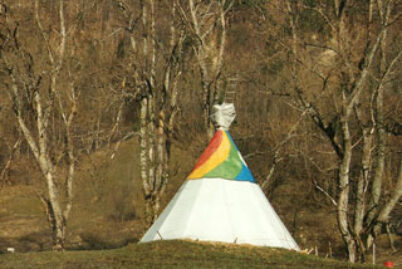
In the middle of winter, trouble with the municipal authorities who, because of our unconventional lifestyle, order us to leave. Birth of son Nicolas while still in the 2nd tepee. We give up this tepee towards the end of February and leave Switzerland, travelling by car through Italy to Southern France looking for a piece of land to buy for a self-sufficient life together with others. Nomadic life with apprenticeships in self-sufficiency at various places in France and Switzerland. We pass the winter in a new double-skin tepee with an oven and a tube chimney on an organic farm at Vermes in the Canton Jura.
1993
At a meeting we attend of people interested in communes, the project of an “eco-village” in northeast Poland is presented. We take up this new challenge with trip to Germany to meet other people concerned, and then on to Poland to see the country and location. We take the brave (or crazy?) decision to emigrate and join the project. Return to complete formalities for leaving Switzerland and emigrating to Poland.
On June 1, 1993 our permanent settlement in Poland. We rent a piece of land in Sajzy, 20km north of Ełk. We set up our tepee and lay out a vegetable garden. The eco-village project is however cancelled while still in the organisational phase.
With the help of Elżbieta Niedziejko from SIRT and Jadwiga Łopata from ECEAT-Poland an old farm suitable for us is found in Bachanowo and acquired.
On September 5, 1993 we move into this our new home. First renovation tasks. Purchase of two piglets and a flock of hens with a rooster and, by a lucky chance, two goats and a he-goat.
November 9, a sudden attack of winter (very strong wind, temperature falls from +8 C (46 F) to -14°C (7 F) in eight hours, 1 meter (3 feet) thick layer of snow). A shockingly hard situation! But what does not kill us makes us stronger and more experienced. After three weeks, the nightmare is over – winter is returning to normal. Initial contact has been made with several neighbours and a small radio has been purchased – knowledge of the Polish language is improving day by day – the incredibly good Polish music scene is delightful!
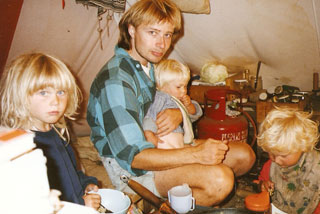
A parcel arrives from Switzerland with gifts for the children. It also contains a simple camera so that photos can be taken for the grandparents. At last we can take photos ourselves again.


1994
A hard, simple and modest way of life. In February, -25° and much snow. In March the first goat-kids are born, the he-goat and a pig are slaughtered. The second pig is sold – our first modest earnings in Poland.
End of March: the snow is gone, we sight the first storks. A first small piece of vegetable garden is being prepared. Then the first sowings – and what a shock – winter returns and everything freezes!
April: Spring has finally arrived, and we are buying a workhorse. A large piece of garden land is being prepared for sowing with the help of a horse and manual labour. Unfortunately, we have to collect an incredible amount of stones that are getting in the way. With the help of our neighbours, 2-3 hectares of land are prepared for cultivation and sown. There, too, everything is full of stones.
May: Our first goat-milk. Official settlement status in Poland is granted. Birth of our son Swendar. In June, we acquire three sheep and a ram, one more goat and a new he-goat.
The first ECEAT-vacationers arrive and the tepee is put up for the first time on our own land. Just during a record heatwave, when it is 37 degrees, we are building a new tiled stove. Shortly afterwards, some of our family from Switzerland are also visiting us and buying us a refrigerator.
Thomas returns one more time for two days to Switzerland to pick up a few remaining things we have there, and arrange the transfer of our car. Lisa begins Polish pre-school and learns to ride a bike. With the new tile stove the house is a lot warmer as winter nears!


1995
A very snowy winter. We bring Lisa to school almost every day on the horse-drawn sleigh. The first Polish TV team appears and makes, in the middle of winter, a short feature report about these courageous (crazy?) Swiss who have risked settling in the impoverished backwaters of northeast Poland. After transmission on Polish television we become well known fast in the whole country.
The experience of last year’s cold spring inspired to build a hotbed box.
The field and vegetable garden work goes now much better than in the first year, and we get in a much bigger harvest. We are recognised as a certified organic farm (by the Polish “EKOLAND” organisation). We achieve our first modest goat-milk cheese production and attract our first customers.
In summer, holiday guests from ECEAT, family members and friends from Switzerland spend their holidays with us and often help out diligently.
Thomas travels in September to Danzig and Kashubia to buy five more goats. Our goat herd grows to 17 mother goats.
At the end of November, birth of our son Gregor.


1996
The longest and snowiest winter yet. The outside world is accessible only by horse-drawn sleigh. We experience many extreme situations in connection with the harsh winter and our simple, if not primitive living conditions.
Meeting Krzyśek, a neighbour’s brother, who becomes a long-standing ‘work angel’! The mare Gniada, the workhorse, gives birth to a foal. Cheese production grows. First attempts at mature cheese, unfortunately with unsatisfactory results in terms of taste. Construction of a new stable and barn building. The kitchen gets an additional window and new windows are installed. Start of insulation work on the house fasade.
Neighbour Kwaterski, the retired headmaster of Bachanovo, gives away an old black-and-white television, an excellent aid for learning Polish, especially during the winter months! The foal can be exchanged for a dairy cow with another neighbour.
In mid-November, a brutal robbery takes place. Almost all the windows are smashed, including the car windows. Thomas is beaten up with a baseball bat and then money and equipment are stolen. Fortunately, he survives the beating without serious injury, and the broken window-panes can be replaced within the next three days, just before the onset of a snowy winter. Worse are the psychological wounds of this traumatic experience – for the five children who witnessed it, they will probably still be there, lurking beneath the surface.
In mid-December, freezing fog causes many electricity pylons to break, resulting in a seven-day power outage!


1997
In January, the new stable is ready for occupancy – Gniada the horse and Brunnhilde the cow can move in and leave the old, dark stone stable.
In March: the first calf and the first cow’s milk. More milk – more cheese… and the mature cheeses are finally a success! – and sell well. More cheese – better income – a significant improvement in living conditions!
At the beginning of July, on the main hay harvest day: Manuela is born.
After approval by three Polish ministries, the farm can finally be notarised and officially purchased.
With the money inherited from the grandmother, a tractor, a tipper trailer, a plough, etc. can be purchased. For the first time, the fields can be ploughed without the help of neighbours.
With eight people in two rooms, the house is bursting at the seams. Planning and design of a house extension.


1998
Fortunately, the winter is relatively mild. This means that in the middle of January, the whole of Bachanovo can be connected to the water supply network – finally, there is running water in the house! However, there is still no waste-water pipe.
The excavator used for the water pipe construction can also be used to dig the foundations for the planned new part of the house. And, miraculously, it remains frost-free for days in the middle of winter! This means that the old house foundations can be secured and the new foundations can be concreted.
At the beginning of spring, the basement is finished and the sewage pipe is ready for use.In between, there is another step forward in civilisation: the entire community Jeleniewo is connected to the telephone network, including our house.


1999
Early January and in the middle of the night, the birth of son Noah!
In spring, work continues in the fields. Many tonnes of stones that have been ploughed up and dug out have to be dragged away or collected. For the first time, two female calves are kept for breeding. After all the sowing work is done, work continues on extending the house, hay is made regularly, and cheese is produced and sold every day.
And because everything is going so well and good forces are at work, a quick decision is made to demolish the old, dilapidated pre-war house and Thomas’s father plans to build a simple holiday home. After four weeks of construction, the shell of the new holiday home, built by a construction company, stands in place of the old house.
Two construction sites and 1-2 helpers (sometimes more, because even a large German family with 6 children actively helps out during their holiday stay!), fields, animals, cheese production and 7 children = 7-day week with 17-hour working days. There is no other way to manage it all.
After a particularly fruitful summer, a very large harvest follows, which can be successfully brought in thanks to the capable support of various construction helpers and guests.
Once the shell of the new part of the building has been completed, we will demolish the old roof in stages and immediately build the new roof.
Unfortunately, it doesn’t go entirely without a hitch. In autumn, in the middle of the night, a thunderstorm tears the protective tarpaulin from the unfinished roof. The entire volume of water from the heavy rain penetrates the wooden ceiling and soaks the sleeping children in their beds. After an hour of work on the roof, drying the floor and changing the bedding, everyone can go back to sleep in dry beds.
This year, however, the weather has been very kind to us. By the beginning of December, before the first snowfall, we manage to complete the entire roof and seal the whole house. We even have time to plough the fields. Then, during the long winter months, we tackle the interior work and insulate the façade. Thanks to Krzyśek’s tremendous efforts, the work progresses visibly every day.
One last time, we celebrate the Festival of Lights in the cramped old part of the house, where there are only two rooms for nine people and all their belongings. The Christmas tree stands in the middle of the clutter of the much too small house.
The interior work is progressing so well that, on New Year’s Eve, at the turn of the millennium, the old house can be connected to the newly built part. The new entrance to the house can be used and the old doorway can be bricked up and fitted with a window. A beautiful symbol for the future.


2000
The old part of the house is now connected with the new part. In January the first room is ready: Claudia and Thomas finally have their own room; clothes and books stored for years in boxes can at last be taken out. The hot water and tiled stove in the cellar, and the entire water installation are also being completed – the bathtub can be inaugurated! The external insulation can also be finished during the winter.
By March Lisa and Nadja can move into their own room. Nature is also waking up again. Goat kids and calves are being born, milk is flowing again and, of course, work in the fields is starting up again. After the sowing, Nicolas and Swendar also get their own rooms. The old part of the house now has only three sleeping occupants, so there is a lot of space available… but Claudia’s growing belly promises that the family will soon be expanding!
Unfortunately, there has been very little rain throughout the spring. In May, all the meadows and pastures are terribly dry. The grass is no longer growing and is withering away, and almost no hay can be harvested. The grain is also suffering. Weeks of futile hope for rain follow.
After various media outlets in Poland had already reported on the Swiss immigrant family, and German television had also been there, a journalist from a Swiss daily newspaper visited for the first time.
A Polish film crew also comes by with the intention of shooting a half-hour (pseudo-) documentary about us. The finished film does not exactly show the real situation, but rather an idealised/distorted picture of it, yet it even wins a documentary film award and is subsequently broadcast not only in Poland, but also around the world via the Polonia channel. Afterwards, we receive some fan mail from Poles living in Australia, America and Switzerland.
Throughout early summer, intensive work is carried out on the interior of the guest house. Although only half finished, the first visitors arrive: friends, relatives and acquaintances.
In the middle of August, just after the biggest rush of cheese customers has passed, our eighth child, Lorena, is born.
The ongoing drought has had significant consequences: there is far too little feed for all the animals! In autumn, the old cow (Waldburga), the workhorse (Gniada) that has been unused for two years, and one jung cow, are sold to neighbours. This ‘downsizing’ greatly reduces the workload during the winter. This leaves more time for further interior work.


2001
The real winter begins on New Year’s Eve. It snows for hours. The new year begins with 40-50 cm of fresh snow and hours of snow shovelling.
Interior work continues in both houses. Now that Brunhilde and the young cow Hulda have calved, cheese can be made again every day.
Once the snow has melted, work in the fields can resume. Until May, tonnes of stones must be collected from the fields, before, during and after sowing.
To encourage farmers to plant trees, the park administration distributes hundreds of tree and shrub seedlings. We can also benefit from this and plant the seedlings we receive on our land. This creates new hedges.
Claudia receives the gift of an automatic washing machine, so ten years of tiresome hand washing and cranking a wringer are at an end.
This summer, we are once again visited by many friends, relatives and acquaintances. Lisa, Nadja and Nicolas can take part in the summer camp organised by the Eko-Art-Village project, which is run by good friends of ours.
Once again, there is far too little rain. The drought is not quite as severe as last year, but the harvests are still below average.
With construction work largely completed in August, Krzyśek finishes his work with us. He finds a permanent job, finishes building his own house and gets married. With only one pair of male hands left, all work becomes slower and more laborious. The school year begins in September: four children are already attending school. Lisa has already finished primary school and is going to secondary school in Jeleniewo (about 15 km to school, 2.3 km are on foot)
The winter crops are sown, the last fields and potatoes are harvested, the fields are ploughed, the garden is harvested and prepared for the coming year, stones are collected, winter preparations are made and… experience shows that winter comes too early and interrupts the last tasks before they are completed. But in the stables and in the house, there is always work to be done.
An authorized interview with Thomas Notter is published in the monthly magazine “Dzikie Życie.”


2002
With the birth of Beata in January, the family grows once again. Otherwise, everything runs as usual in tune with the seasons. Except that this year is terribly dry again. On the plus side, the sun shines most of the time and it is very warm. Lisa, Nadja and Nicolas take part in the Eko-Art-Village project’s summer camp again. A rather crazy and happy summer takes its course.
Due to the drought, harvests are smaller, which means less work and more time for swimming in the pond, social gatherings, having fun and good conversations.
In order to join the EU, rubbish collection is finally being introduced in rural areas of Poland. We also have to rent a rubbish container.
In December, we are in high spirits and finally repaint the walls and doors in the old part of the house – it becomes much brighter and friendlier.
Full of anticipation for what the coming year will bring in terms of new impressions and experiences, we go about our seasonal work and duties as the end of the year approaches.


2003
Extremely cold winter with three periods of temperatures below minus twenty degrees. During one of these periods, the temperature drops to -36°C at night and even during the day it remains at -26°C. The following night, it is a milder -28°C.
Apart from the record cold, 2003 went down in history as the ‘year of the cows’. Three cows were bought and two were sold for slaughter. As a result, the herd grew by one cow to three; all of them fitted with the yellow EU ear tags that all cattle have been required to wear since 2002.


2004
A very work-intensive year with record cheese production. Poland joins the EU. Farmers can apply for direct payments and farmers who are not Polish citizens can finally join KRUS (Farmers’ Social Insurance Fund).
Lisa ends middle school in Jeleniewo and begins attending the “Liceum (secondary school) Dönhoff” in Mikolajki. Nicolas begins the 6th grade in Jeleniewo.
A light, but for our region very unusual earthquake is felt on September 21. Shortly after that, on October 2, we take a big step into the future with the purchase of a computer.
In November, after a miscarriage with the consequence of a serious sepsis, Claudia is laid up for several days on the intensive care station at the Suwalki hospital. For two days even her survival seems uncertain. But she apparently decides to live and six weeks later is fully recovered. Through this extreme experience, and in connection with medical treatments and their consequences, health worries seem to get the upper hand for some months. We feel trapped in some kind of “interactive game”, in which we are faced with the dangers of illness, hypochondria, doctors and the weaknesses of the Polish health-care system.
2005
The harsh winter months become a nuisance for us due to the loss of physical and mental balance. Only the renewing energy of spring brings relief and helps restore health and balance.
After 10 years of independent organic farming on our fields, we are once again a certified organic farm, which, in addition to a lot of paperwork and inspections, now also brings us considerable financial benefits – which we urgently need in order to bear the ever-increasing financial burden that such a large family entails.
Again we are plagued with periods of drought.
We are enlarging and adding windows to the chicken coop.
2006


2007
On our farm, we have once again a busy schedule of visitors and community rehearsals throughout the entire summer.
In October, Lisa begins studying German language and literature at the University of Olsztyn. A slurry tank is built and the goat enclosure is enlarged and improved. By November, we already have three weeks of winter, followed by an autumnal December.


2008
Once again, winter really kicks in at the turn of the year. In the first week of January, accompanied by very strong winds, the temperature drops to -16°C. The drinking troughs in the barn freeze over and all the animals have to be supplied with water from buckets, which have to be laboriously carried from the house.
Gregor breaks his arm in a bicycle accident on the completely icy road to school, which results in him having to wear an uncomfortable plaster cast and his parents having to make trips to the hospital.
Spring thaw, with snow melting and heavy rainfall, and only superficial thawing of the deeply frozen ground, leads to our driveway becoming badly muddy. Despite these precarious road conditions, we have many visits from friends and acquaintances.
In February and March, we finally manage to complete the interior work that began eight years ago and then was left unfinished. As usual, there is a lot of paperwork to do. We decide to computerise the entire ‘farm administration’. This process takes the whole year. After some initial extra effort, the many advantages of this innovation quickly become apparent.
Our own trilingual website, www.realearth.pl, is finally complete and online. Thomas’s brother offered to create a website for us. The basic concept was ready at the beginning of 2007, but it took over a year to write and translate all the texts, select suitable photos and digitise old photos.
Based on a spontaneous impulse, we manage to organise an Oekoplausch meeting over the long May weekend. For the first time after a break of several years, we even set up one of our teepees again.
In spring, the dry weather causes problems at first, followed later during the harvest season by persistent damp and wet conditions. Some of the harvest rots or moulders. Throughout the summer, many visitors and individual helpers come by again. A small-scale week-long camp is also held for people interested in eco-villages.
After the summer holidays, the seven children who remained at home go to school in Jeleniewo. They all enjoy finally being in a proper school with lots of classmates. The school in Bachanowo is closed down and then converted into a community centre with EU funding, complete with a computer room and lots of play facilities.


2009
Every year brings us its special surprises. This time it is first a curious email that reaches us in February, in the middle of the snowy winter. “Pan Wu”, an acquaintance who has been passing by us from time to time for years, asks us if he could spend his annual Lent with us. Since we are particularly welcome in winter some variety and company, we agree. From the originally planned approximately two weeks, then full two and a half months. Pan Wu has cross-country skis and skates with him – and the winter is amazing!
Almost the whole month of March, there are exceptionally good conditions for cross-country skiing – also Claudia’s favourite sport – almost daily they glide over the snow-covered fields. And Pan Wu shows us how great it is to ice-skate on our biggest pond. Claudia is back on the ice after more than twenty years, but she can do it again.
Manuela, Lorena and Beata make their first tentative attempts, but under the guidance of Pan Wu they become safer every day. He is also a good storyteller, likes to cook typical Polish dishes, tells us a lot about Polish culture and history, and at the end of winter he gets the whole family to burn a marzanna doll according to old custom. After that, spring can finally arrive and in growing anticipation we make the decision to buy an 18 square meter glass greenhouse this year. As soon as the last snow is gone, we build the concrete base. Pan Wu helps with this, but then he itches with a springlike urge to travel and soon he starts with a packed bicycle towards the North Cape. On the way back, he gets stuck in Tromsø [ˈtrumsø] in northern Norway, meets a Polish woman, marries her and starts a family.
Aunt Marion from Switzerland sends us a 4 kg chocolate bunny for the Spring Festival. In May the greenhouse is ready and can be planted. Nadja is graduating, but doesn’t want to study. She moves to Białystok, living with her boyfriend and his brother with girlfriend. She does occasional jobs and sets out to make a childhood dream come true, namely to write a book.
Then at the beginning of summer, the next surprise knocks at our door. It is a young guy, Jarek called “Tarzan” by the children, who heard about us somewhere and wanted to spend the summer with us.
The fact that we don’t have a free bed in the house doesn’t bother him – he sleeps in a sleeping bag for two whole months under the fir tree next to the barn. Only in September it gets so cold and rainy that he lives in the cottage with Zuza, who also happened to join us, for two weeks.
During the summer holidays Nadja and Lisa with her boyfriend Mateusz come and also the brother of Thomas, with his wife and two children. There is a good atmosphere at the farm with lots of entertainment and fun. In addition to the whole summer holiday rush, hay and gardening are also diligently done, milked the cows and goats and cheese produced – and hundreds of customers are also served.
In September we receive an invitation to sell our products at the annual market at the Wigry Monastery. Nadja and Zuza were thrilled, so we embark on this adventure. It’s the first time we don’t sell our products directly from the farm, but it’s the only time.


2010
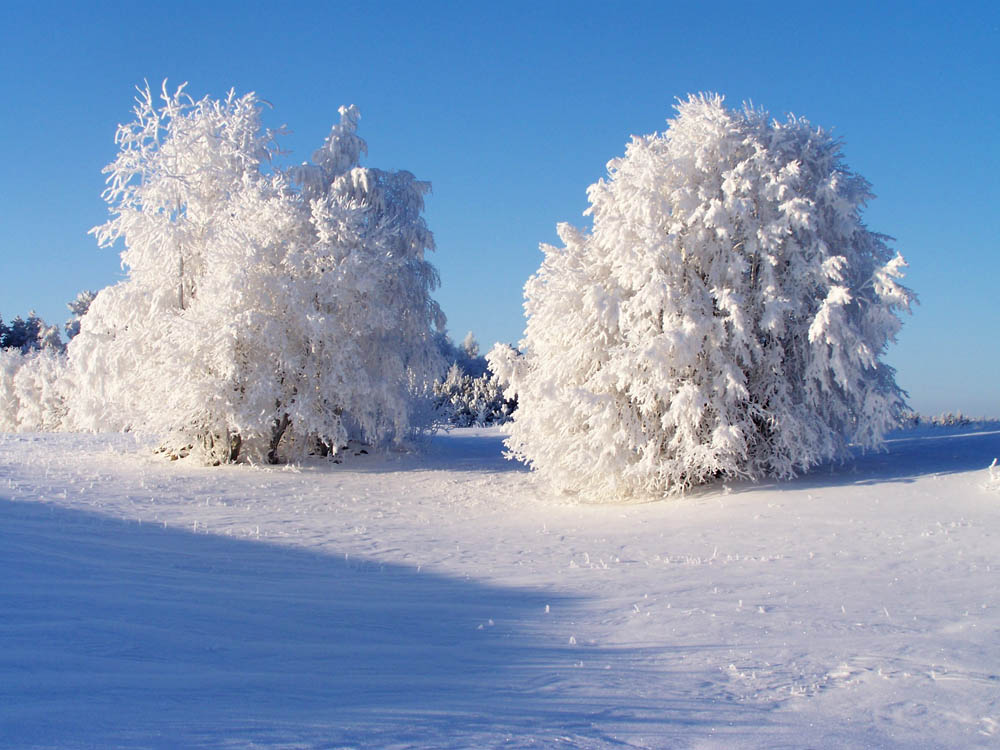
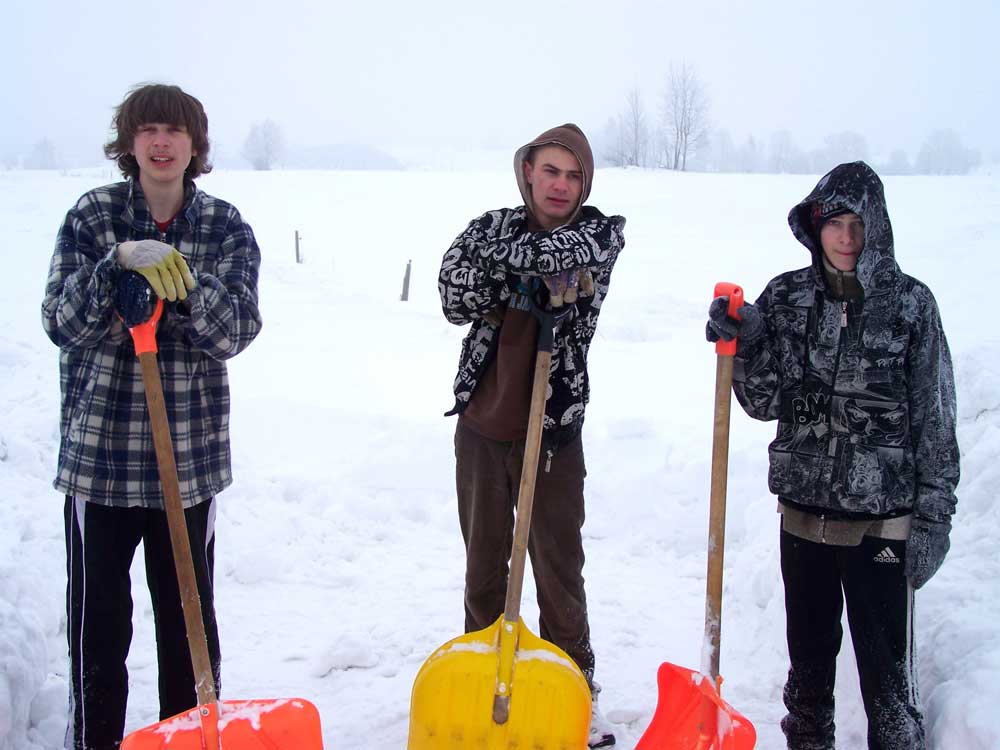
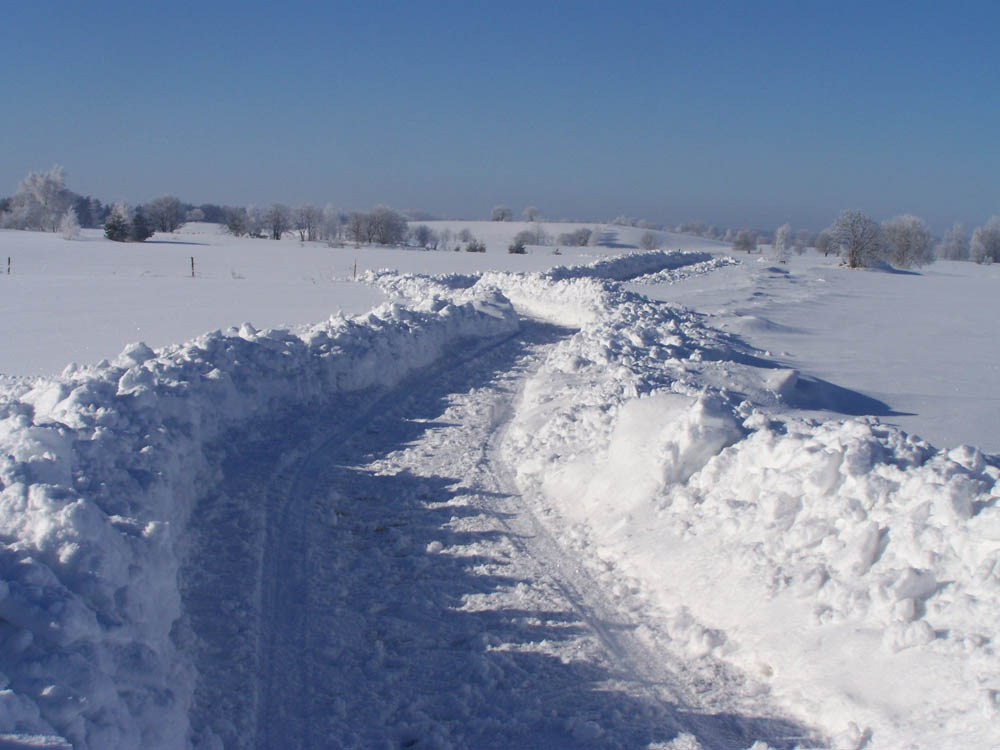
January is snowy and very cold. We spend many hours clearing our access road. But we are also compensated with fairytale beautiful landscapes.
Claudia has long wanted a storage shed for all the gardening tools, pots and other things. So the men’s team gets to work and builds her one.
Three years after the application, we finally get Polish citizenship at the beginning of April. It’s a great feeling for us to finally be fully-fledged citizens. Tomek our future son-in-law even gives us a Polish flag. Two months later, we can already take part in the presidential elections.
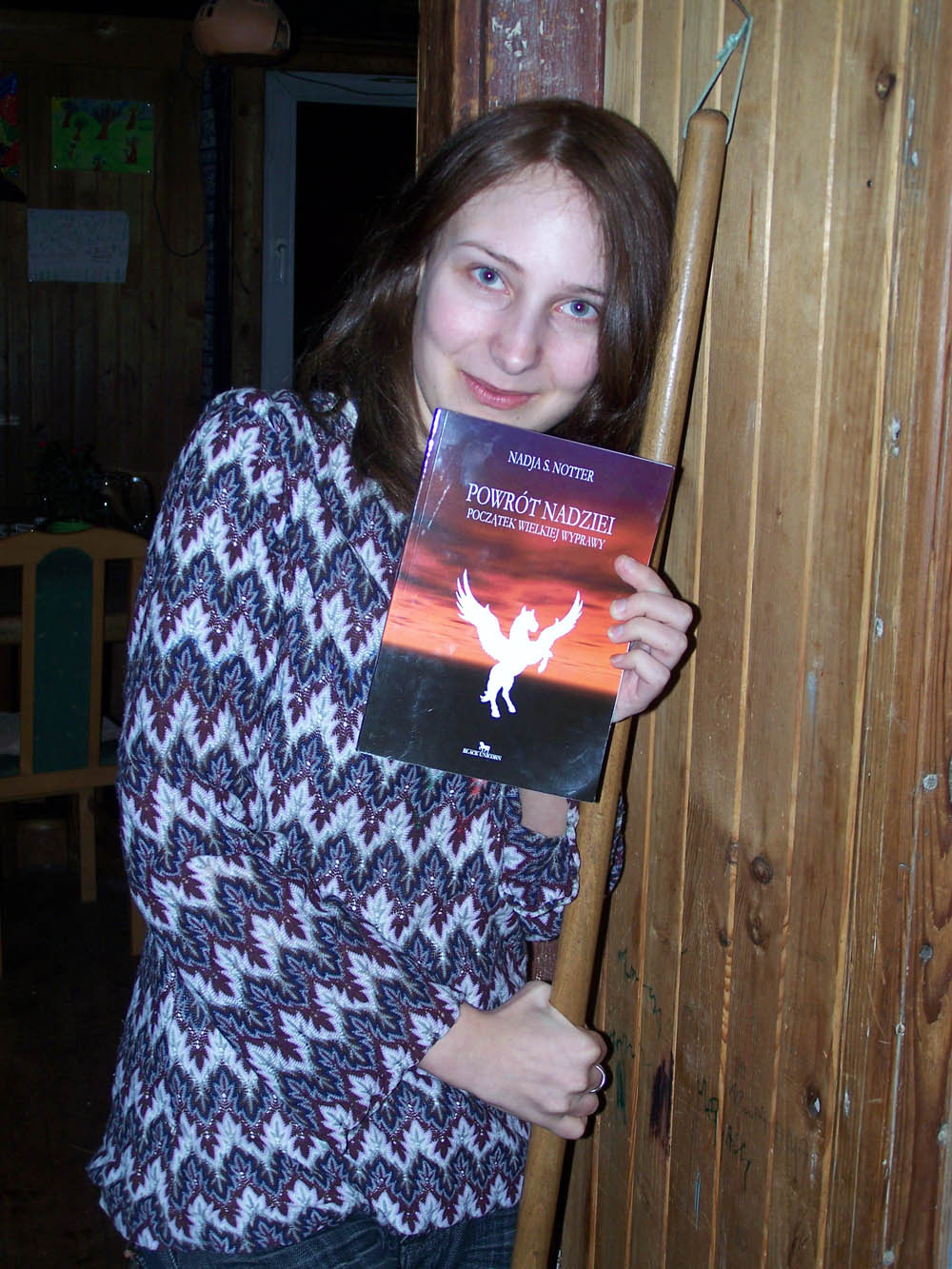
Nadja becomes unemployed because the company closes where się finally got a permanent job. But she has also finished her book “Powrót Nadzieji”, a fantasy novel for young people, and it is being printed.
Nadja receives an 11-month internship at the municipal administration of Jeleniewo from the Labour Office. For this time, she lives with us again, with which we once again become a family of ten.
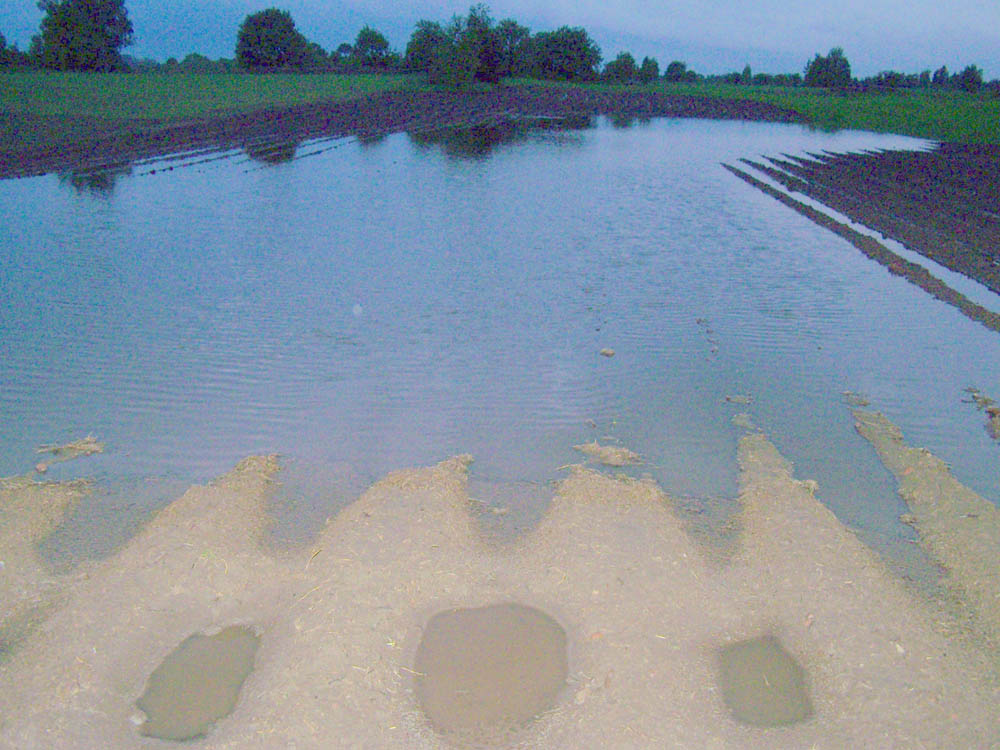
In May, just one day after planting the potatoes, we experience the most intense rainfall since we live here – 13cm in almost 3 hours on 2 days. Two-thirds of the potato field is flooded and another field holds a 0. 3 hectare lake of water for days. Thanks to the abundance of water in the soil, the meadow grass grows particularly lush. We can bring in a lot of good hay from the first cut. In the following dry season, however, these water masses are quickly used up again and so we are plagued by a drought, so intense that half a hectare of unripe vetch is completely dried up and can only be ploughed in, yet.
At the request of the female family members, we buy a riding pony. The little mare’s name is Elsa. Unfortunately, she is not properly ridden and still youthful naughty. Kindly helps us the new neighbor Małgorza and makes riding training with Elsa and the girls.
Because Elsa is the only horse on our farm, she later joins the cow herd on the large pasture. It also turns out that she is incredibly loyal to the place, that we can just let her run free during the non-vegetation period.
For almost a year now, we have on the horizon the view of the wind farm in front of Suwałki.
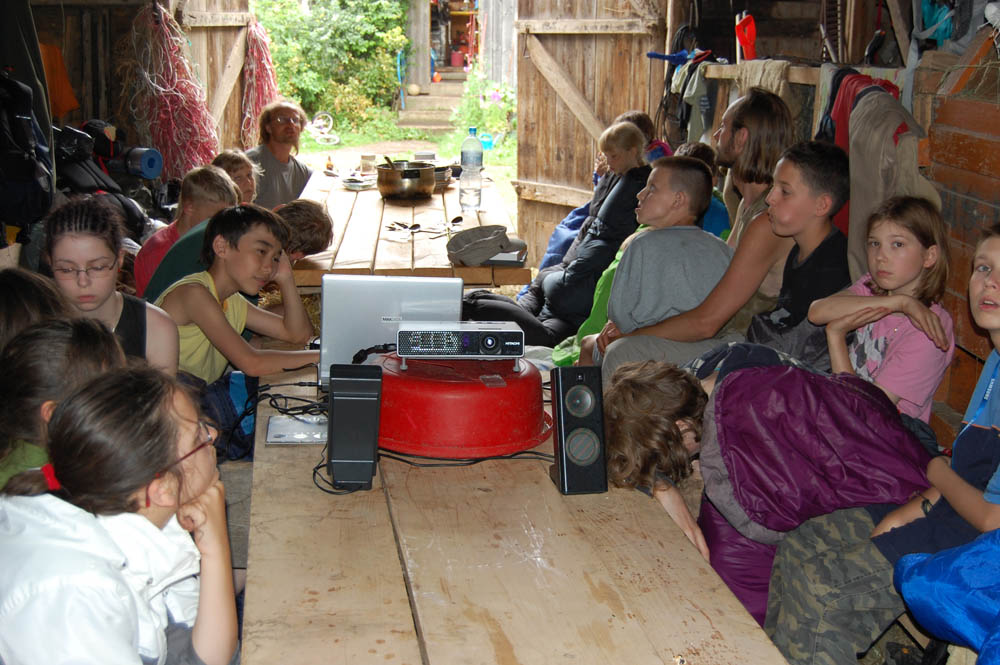
Lorena and Beata are invited to participate in a summer camp, organized by friends in Szurpiły . During a two-day hike, the whole group comes to visit us for lunch and cheese demonstration with tasting.
Between the autumn field work, we replace the leaky wooden front door, distorted by the extreme temperature differences between inside and outside in winter, with a new, tight and thermal insulated metal door. In front of the house entrance, the cow shed and the barn, we finally put a solid floor covering and a drainage pipe.
The traditional gingerbread house has been particularly beautiful this year.








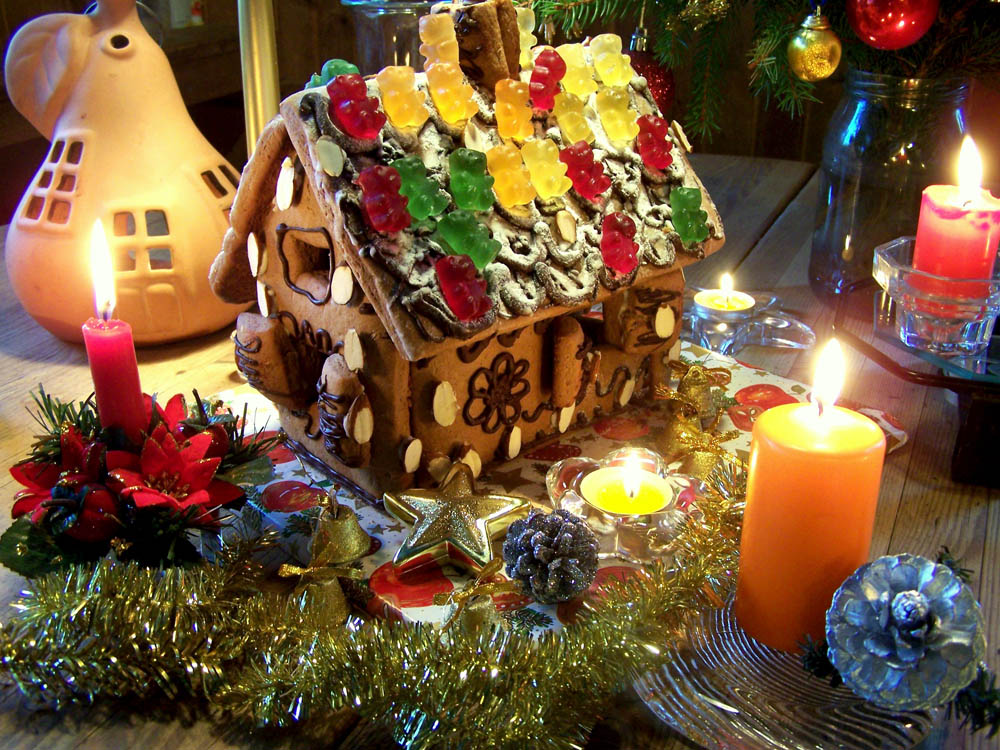
2011
We are increasingly experiencing the negative, very restrictive aspects of the EU. For example, since the beginning of the year, we are no longer allowed to slaughter farmanimals ourselves. It is now only possible with permits, inspections, and fees – a deep restriction of the fundamental rights of the free man and the peasant. Polish regulations are usually even tighter than the basic regulations of the EU, putting small farmers and producers, who are still directly linked to nature, life and inter-humanity, in increasingly absurd situations. Much is more and more reminiscent of fascist oligarchy and communist planned economy. Self-responsible being, thinking and acting is becoming more and more restricted.
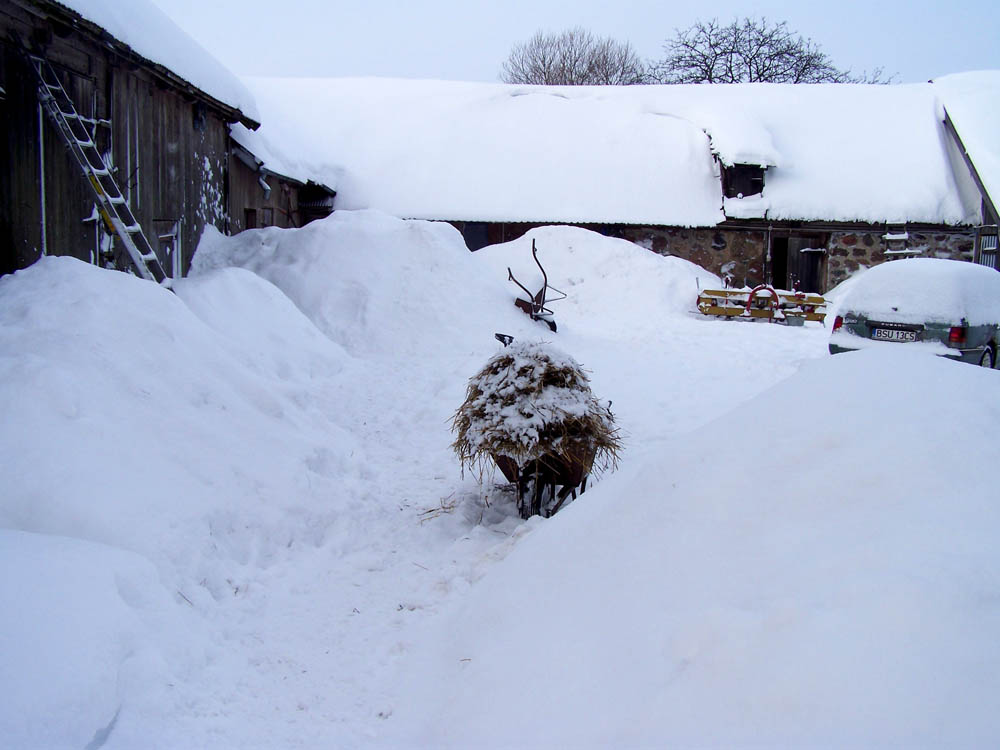
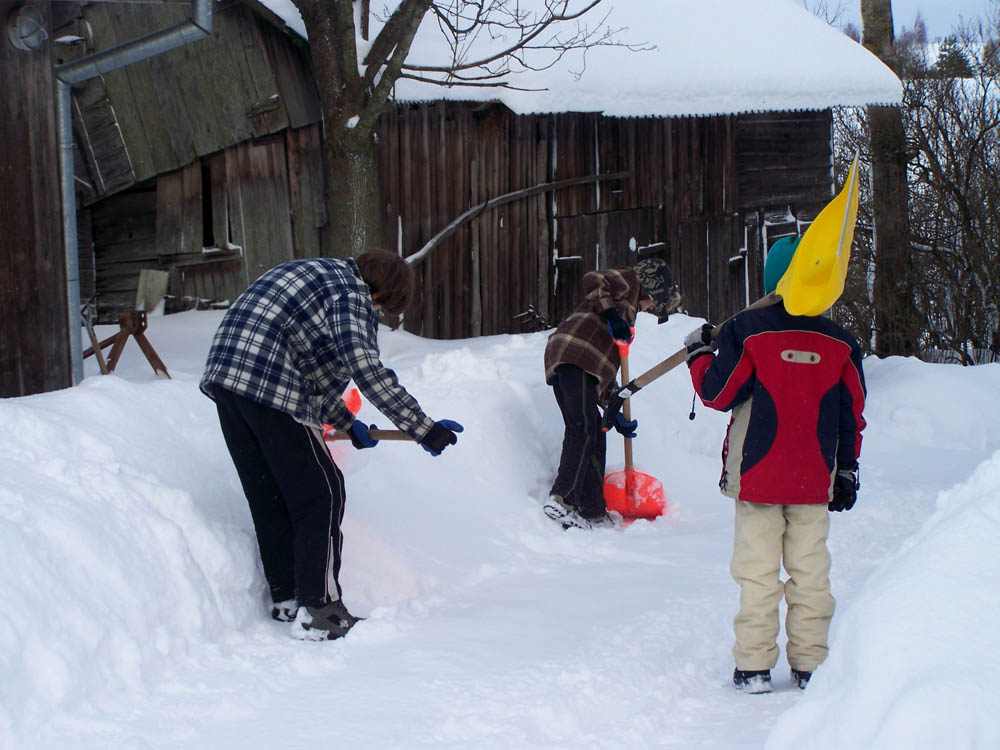
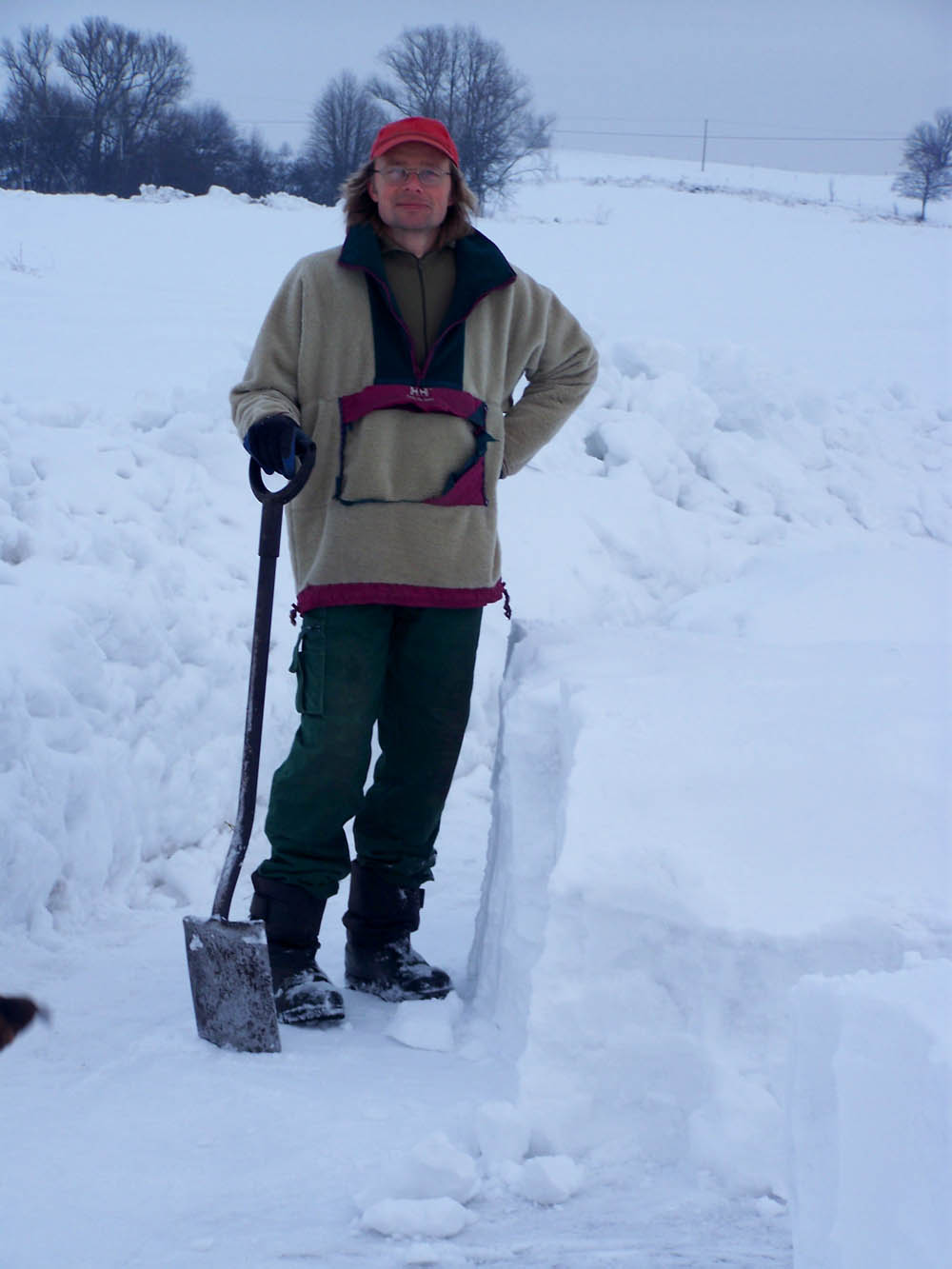
From the very first days of January, such large amounts of snow fell, that we were cut off from the outside world. There was much more snow than in the year before. The piles of snow almost reached the roof edges, and they were regularly busy shovelling paths clear. But it got worse and worse until after a wet snowstorm the entire driveway to our farm, was filled with a layer of snow up to 80 cm thick, that was freezing over night. This snow was way too hard for the shovels. Only the spade could help. Unfortunately only Thomas remained from the snow clearance team, because the others had to go to school, so it took more than a week until the driveway was passable again.
Spring had a very special aura this year – a pair of black woodpeckers nested with us in the big old poplar tree, it was a big honor for us! You could hear their magic knocking and shouting, but they didn’t like to show themselves, they are very shy birds.
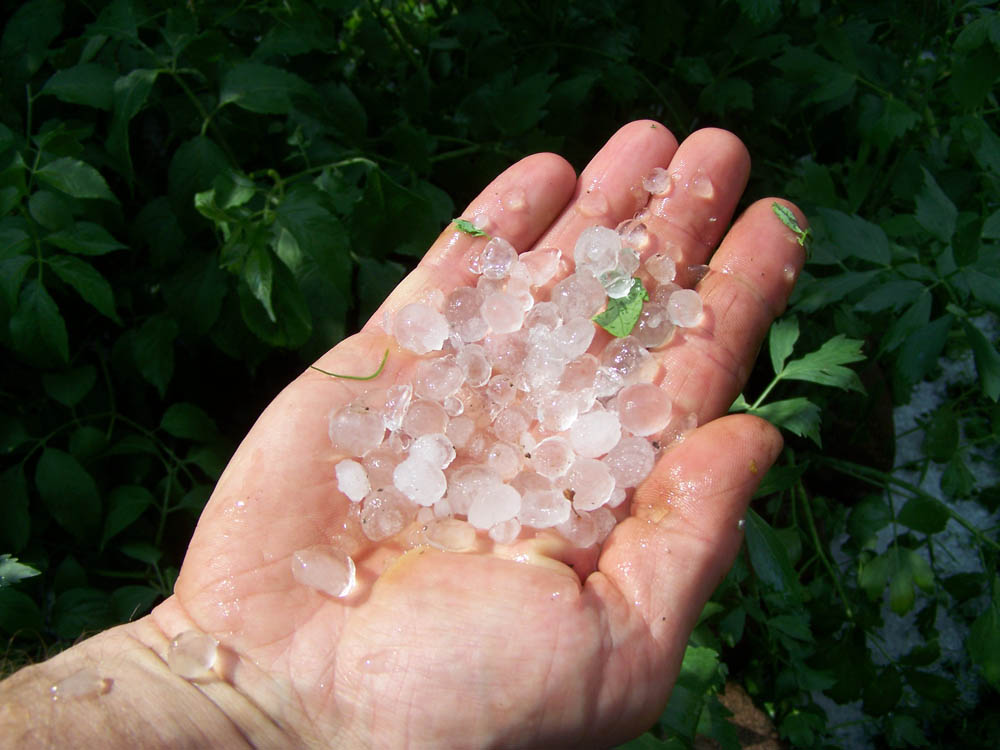
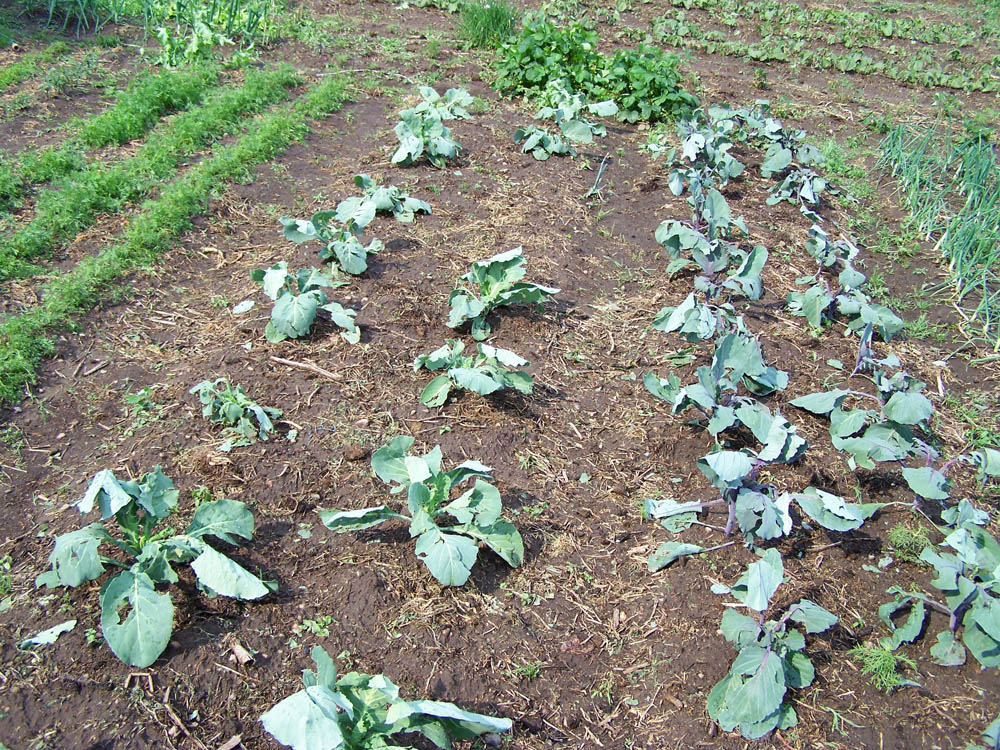
In May we got hit by a hail front. The young vegetable plants in the garden were badly damaged afterwards and larger leaves were perforated, but fortunately there was no serious damage to crops otherwise.
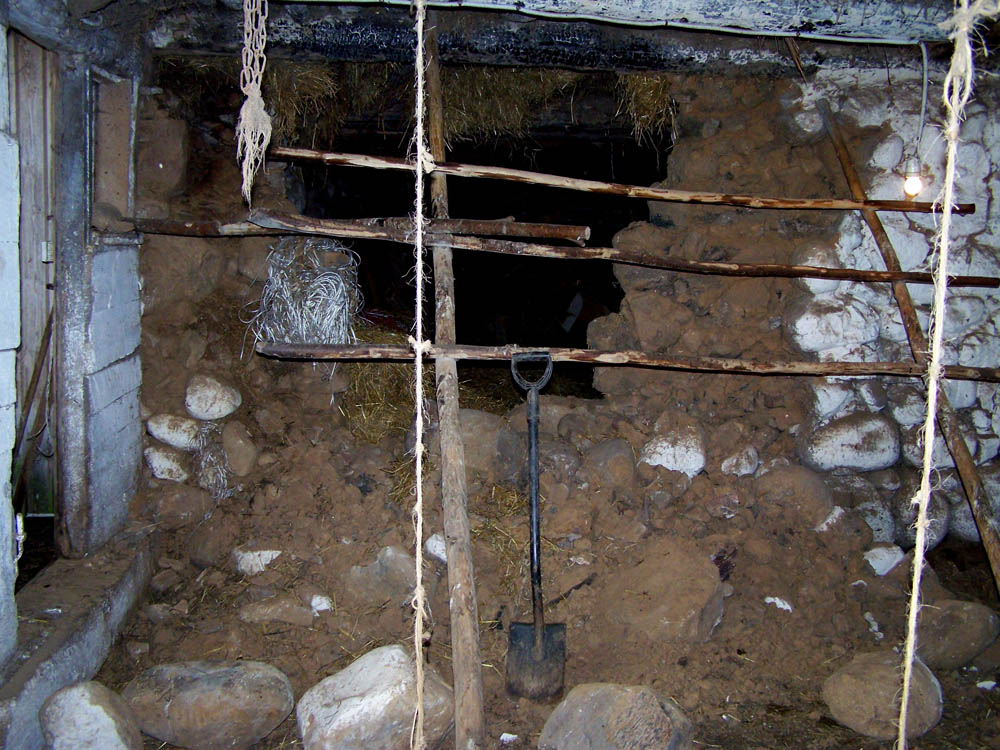
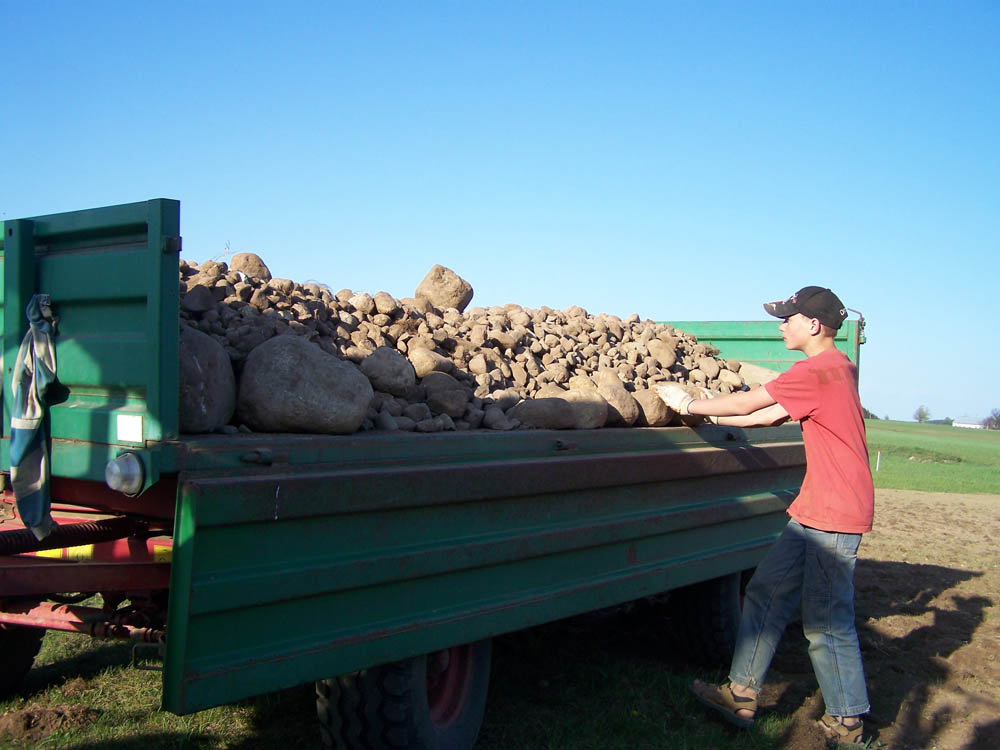
As if it were not enough, that there are tons of stones on the fields to clear away, so one June morning the chicken coop floor was buried with large stones. A part of the stone wall collapsed because the big foundation stones had been loosened by the pigs rooting in the 90s. We had to remove the stones quickly and repair the wall provisionally so that the chicken coop was functional again.
After the broadcast about us on Radio DRS 1 “Die 5. Schweiz” , our website was visited by more than 1000 listeners.
During the summer holidays we got the annual family visit from Switzerland and the young guy Michał W. was living and working with us, all the summer long into the autumn. He wanted to learn how to farm a piece of land organically. With his skilled help, many works could be done easier and we also managed to do much more, than usually possible.
This year we collected 36 trailer loads of stones away from the fields (at least 100 t), which was an absolute record.
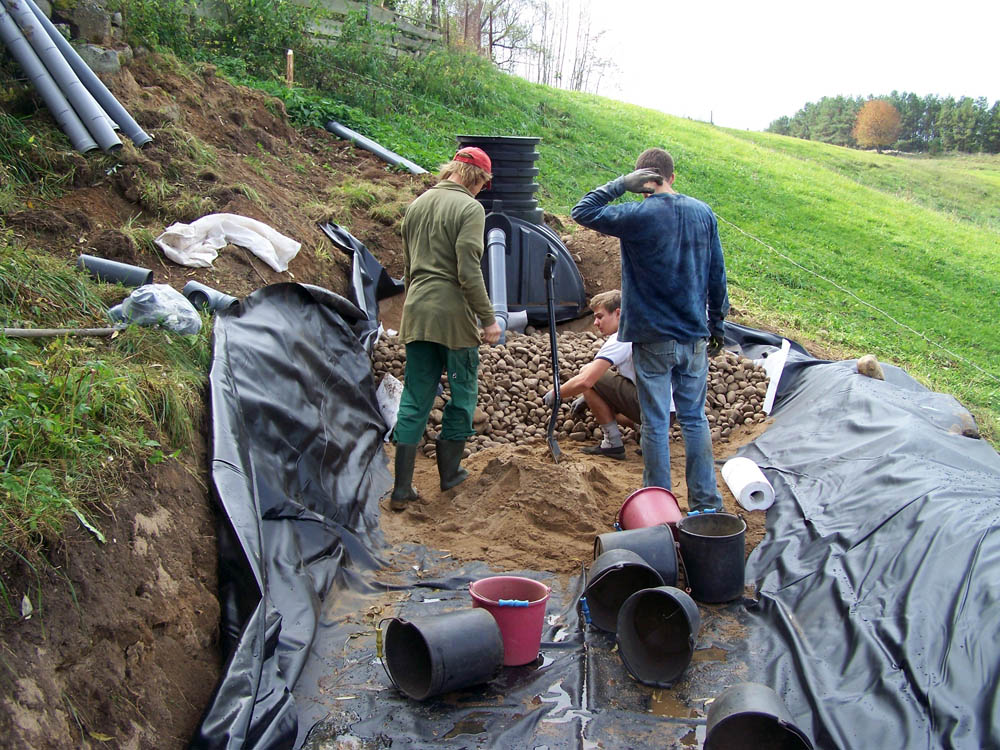
After the harvest, we began building a plant-based sewage treatment system for the guest house and planted more trees and bushes into the hedges.
At the end of the year, we had a visit from a sled team with husky dogs.
2012
It seems that a Russian wind blew through Bachanowo. Right at the beginning of the year, we had cheese customers from Russia (Kaliningrad) visiting us for the first time, and the children were able to put their school Russian skills into practice.
Shortly afterwards, the Russian-language Polish monthly magazine НОВАЯ ПОЛЬША (‘Nowaja Polsza’) asked if they could publish a translation of our website in their February issue. Of course, we agreed – and Thomas was motivated to learn more Russian.
At the same time, we were hit by a Russian cold snap – for two whole weeks, the temperature remained below -19 degrees during the day and between -22 and -30 degrees at night!
What a one-sided winter! – it only showed us its unpleasant side. The children were only able to play in the snow on three days, Claudia was able to go cross-country skiing twice, and we were only able to go ice skating on two days; otherwise it was too cold, too much snow, too wet or otherwise too inhospitable.
Danuta and Darek, friends from southern Poland, visited us for the spring festival – and they brought bows with them! Everyone was allowed to try shooting, and everyone loved it. Nicolas together with Gregor, and Manuela together with Lorena, bought a bow and began practising regularly, aiming at buckwheat straw bales, which are hard enough.
In the middle of summer, a black-haired man unexpectedly appeared at our door. He was an Iranian physicist from Yazd who was in the area for a clay building course and had heard that Swiss people settle here and make cheese – and he wanted to learn how to do that and then try making cheese himself at home in Yazd. So the next day he came for an intensive internship and there was an intense and very exciting cultural exchange. We can no longer travel around and go out into the world, but the world comes to us!
From 25 to 30 August, the fifth edition of Cook it Raw took place in the Suwałki region. Thirteen of the world’s best chefs spent these days in this region of Poland to ‘seek the spirit of this region, feel the symbiosis between man and nature, and find natural sources of produce’.
On the last evening of the five-day event, we were invited to a festive dinner together with many other people involved in the event. Each of the thirteen chefs prepared one dish using only natural local ingredients, most of which were gathered in the wild.
It was a unique change from our hard-working life in the countryside. It’s the kind of event you probably only experience once in a lifetime – but a film was made during the project that captured the entire event and its atmosphere for a wider audience and posterity. ( Wtajemniczeni / The Initiated by Maciek Kowalczuk ) Unfortunately, the film cannot be viewed on the internet; only a trailer is available. (Trailer of the film)


2013
2014
2021
At the end of January and in February there is again a lot of snow. An ice fog, lasting several days, causes great damage to birches, pines and spruces. Shortly after, a storm wind breaks and uproots more trees.
At the end of January our fourth grandchild is born in Suwałki. With the melting of snow, the groundwater finally rises again and thus also the water level in the ponds.
Lorena’s coming back from Estonia. Then she travels to Switzerland to do an internship there in a cheese-dairy and then possibly a vocational training as a cheesemaker.
Beata finishes high school with the Matura. With this, we can finally – after 27 long years – conclude the subject of “school”. On June 2, a long cherished dream comes true; with the newly installed solar collectors, we produce our own electricity. The surplus electricity produced from the summer is easily enough to get through the winter without electricity bills and to give away more than 2000 Kwh into the grid.
Lorena drops the training plans to avoid falling into absurd Corona restrictions. Throughout the summer she helps with us and organises exciting company via “Workaway” (https://www. workaway. info/).
Right after the grain harvest, a rumour begins to become a visible reality. They start with the construction work, putting an ugly, metal look-out tower in our field of view. The management of the Landscape Park!” transforms the landscape itself. (https://spk. org.pl) Of course, without prior consultation or at least information of the closest residents.
In September, a single wolf (probably a hybrid wolf?) roams the area. It also passes by us – kills our he-goat, drags it 100 m wide – and eats it almost completely. Only the thicker bones will be found later.
Beata starts studying geology in Krakow. Noah begins his second year of studies. In order to have time to look for work, a couple of Belarusian emigrants come to us in autumn via Workaway, for a whole month. They help to clean the buckwheat and lupins, as well as to prepare the fields for winter grain sowing – there are tons of stones to
remove and we build new field stone walls with them. They are also there for the potato harvest, so we can get this job done quickly. Then they move on to Norway.
In mid-October, two women with three children from East Germany come over for a few days via “Eurotopia”. ( https://eurotopia. Directory/ )
At the end of November we are already in winter snow. Already in December the terrible look-out tower is ready – the sight of it instinctively triggers an unpleasant feeling every time we come out of the house and the gaze always
falls on this tower first, checking whether someone is up there or not.
Shortly before the turn of the year we cut down the many damaged trees in the forest. We plan to have the good logs sawn to timber by a mobile sawmill.


2022
Heavy snowfall alternates with warmer days, causing almost all the snow to melt – but then it cools down again and snows heavily again.
Winter is underway, the snow layer is getting thicker and denser because of the snowdrifts. In the third week of February it gets so uncharacteristically warm that all the snow, except for a few particularly thick layers, melts incredibly quickly. Then it gets quite cold and frosty for five weeks, but also very sunny!
The weather is favourable for forestry work. During the last days of February and until the end of March, the forest can finally be cleared of fallen and broken trees . Gregor helps for two days, otherwise Thomas works alone.
We are confronted with the fact that the mobile sawmill only has a free date for us in October. Most of the forest owners in the region have large amounts of storm wood, so all the mobile sawmills are working at full capacity.
Throughout the spring there is regular heavy rainfall. All the vegetation is luscious and green. The meadow grass grows wonderfully, just how do you turn it into dry hay?
At the beginning of July the rainfall becomes less frequent and then from the second half of the month it disappears. First of all, we are happy because thanks to the dry weather we can manage the huge amount of hay with just the two of us and a little help from Claudia.
We can also harvest the grain easily, the quality and quantity are very good.
By August it is already so dry that the grass can only grow back poorly. The second mowing of the hay yields only a small amount of hay and forage in the pastures is becoming scarce. The apples are small, ripen far too late and often rot on the tree.
Jonathan L. Ramsey, an American documentary filmmaker from Chicago who has lived in Warsaw since 2012 and is married to a Polish woman, is making a documentary about us. (https://www.youtube.com/results?search_query=ramsey+united) (Ramsey United)
The drought becomes really troublesome in September. The fields for the winter cereals (rye and spelt) should actually be ploughed urgently, but the soil is far too dry for this. The pasture grass is no longer sufficient to maintain a good milk yield for the cows, so we have to feed them additionaly with hay.
Hoping for rain was in vain. At the beginning of October, it is impossible to wait any longer, it is essential to plough, otherwise the seeds will not be able to germinate before winter.
Fortunately, a wonderful Belgian family is stopping over for a few days on their year-long campervan trip through Europe. They actively help to ensure that the fields are quickly ready for sowing and that the Kosztela apples can even be harvested. We also get aerial photos of our land because they have a drone with them. The good time together passes far too quickly because they want to drive on to southern Poland due to the frosty nights.
Noah briefly returns from Greece. In November, he will be travelling to the Greek island of Kefalonia to help with the olive harvest as a volunteer.
Then the mobile sawmill finally arrives. All the logs are sawn into boards and beams and put under the roof before winter.
This is followed by the sowing of spelt and rye. After that, the ploughing of the remaining fields can begin.
Lorena comes for a short visit at the end of October and as Claudia urgently needs a change after the tough summer season and Noah has to go to the airport, the three of them travel to Krakow by train. Beata is already eagerly awaiting for them, to finally show her mum her great study city. Thomas stays on the farm alone with Gregor and the farm animals.
On 1 November, Jonathan L. Ramsey releases the film shot in August on YouTube. There is great interest in the film and the viewing figures rise quite quickly. Thomas is completely overwhelmed answering the large number of e-mails that arrive. As one of Jonathan’s early films, unfortunately too much footage is ‘squeezed’ into just one 29-minute section. There are too many quick scene changes, picture and sound often don’t match, so many things are not shown and or explained clearly enough, so some misunderstandings are pre-programmed.
After a week’s holiday in Krakow, Claudia comes back satisfied but still not in the mood for the Bachanowo routine. As Thomas has obviously managed somehow all the work without her, she takes the opportunity to travel to Switzerland and visit her family there.
As soon as Claudia has left, winter arrives all too soon again. Snow, ice and frosts of up to -10 degrees suddenly interrupt the late autumn work in the fields. Thirteen piles of ploughed up stones remain on two fields, waiting to be removed. The goat shed has not yet been mucked out either.
In response to the YouTube film, Jacek from Poznań spontaneously comes over for a four-day trial visit. He helps out diligently, we muck out the goat shed and can even clear away a few stones from the field, which surprisingly, despite the snow and cold, are not frozen solid due to the dry earth and can be easily removed with a light tap.
After almost three weeks away and a 28-hour bus journey, Claudia arrives late in the evening in Suwałki with a lot of luggage, where she is of course eagerly awaited and picked up.
Back at home, there’s lots to talk about and a big suitcase full of surprises to unpack. The very next day, after a long night’s sleep, Claudia decorates the house for the rest of the Advent season and gets busy cooking and baking – the menu becomes more varied again and it gets cosier in the house.
We spend the Yuletide in a small family circle. Only Gregor is with us, Beata stays for a few days and Nicolas and Nadja drop by briefly with their families, everyone else is far away – in southern Poland, Greece, Portugal and Switzerland.
Kinga and Krzysztof arrive at the end of the year. With a few interruptions they spend a part of the winter with us.


2023
New Year’s morning starts frost-free with glorious sunshine, such pleasant days are very rare here in winter. Let’s hope that this is a good omen for the whole year. In the afternoon, clouds start to gather again. Nevertheless, we take the opportunity, together with Kinga and Krzysztof, to finally plant the few tree seedlings that have been standing around in two buckets on the front steps since the onset of winter. In the evening, however, snow starts to fall again.
Noah, our youngest son, returns from the olive harvest in Greece and stays with us for the remaining weeks of the winter.
Then it snows so heavily that the access road to our farm is no longer passable. Only on the fourth day is the road cleared of snow, that it is passable again. This is followed by a warm front with lots of rain. All the snow disappears surprisingly quickly and on two rain-free days (14th + 16th January), Thomas even clears stones from the field. But it’s about to get really wintry again.
At long last! After 15 years of standstill, the renewal and updating of our website gets underway. But when the outdoor work starts again in early spring, and at the same time the very complicated new 5-year plan for the crop rotation has to be made urgently, the new website is unfortunately not ready and cannot yet be uploaded.
In the second half of March, there is no more snow and the ground has thawed. Conditions are ideal for ploughing and this is urgently needed. Due to a new regulation, only 20% of the arable land may be ploughed in autumn, leaving some for the spring. It is also a good opportunity to plough again the fields that were badly ploughed in autumn because the soil was too dry, which also helps to limit the development of weeds. Unfortunately, this also means twice as much stone-clearing work – but it also has the positive effect of producing a lot of material for further building of the stone walls.
The fields are only ready for sowing in the third week of April, when it is already getting drier every day because it no longer wants to rain.
The whole spring is chronically too cold and from May onwards too dry, only a few nights are frost-free and there is no rain at all. The seeds germinate slowly and poorly – nothing really wants to grow. The cows can only go out to pasture in mid-May, where the grass is very poor. After two severe night frosts on 3 and 4 June, the potato plants and some of the flowers in the lower garden freeze. The vegetables in the garden need to be watered often to prevent them from withering – Claudia is annoyed and frustrated.
The meadows have little juice and vigour, the cows are only producing half as much milk as last year. Haymaking is easy because the quantity is very low and the mown grass dries quickly in the current drought. Unfortunately, after the first cut, we only have a quarter as much hay as in 2022 – on the worst meadows, only a tenth of the previous year’s quantity can be harvested.
The dry summer allows us to carry out the planned renovation of the barn roof. In five construction stages, between haymaking and grain harvesting, we work our way forward until the roof is finished in the first week of September. Gregor had to take a few days off twice, otherwise the amount of work would have been unmanageable.
September is unusually warm and very sunny, we have more tomatoes ripening than ever before, even the pumpkins, which we had already given up, are still ripening.
Annoyingly, last year’s scenario repeats itself after the harvest: once again, the pasture feed is no longer sufficient to maintain a good milk yield for the cows. This year, however, it is not possible to feed additional hay, which is urgently needed for the winter – so there will be less cheese.
Due to the lack of water, the soil is again terribly hard and can only be ploughed with new ploughshares, with great difficulty. But on half a hectare of clay soil, nothing works anymore, the ploughshares just slide over the grass. The only thing left to do is to sow the ploughed area as quickly as possible and hope for rain for the rest.
It doesn’t finally rain until mid-October. One week later, all the winter cereals are sown, exactly on the last possible sowing date and one day before a first and single snow day. The following day, the snow melts again, but due to the persistent cold weather, it takes over three weeks before the seeds finally germinate – and shortly afterwards we are once again hit by winter, with little snow and many frosty cold days.


2024
After two harmless winters, we are once again being frozen through. The thermometer at an altitude of 3 metres shows -20 degrees on 7 January and even -22 degrees on 8 January. The water pipe in the barn freezes, so once again we have to carry buckets of water from the house to the animals. Fortunately, it quickly warms up again and after three days the water is running again.
Elsa, our old pony, dies during the worst of the cold.
Miraculously, there is finally a lot of precipitation – snow and especially a lot of rain.
The water in the ponds is fortunately rising to one of the highest spring water levels since we’ve lived here.
The real winter is over quickly, but it doesn’t really want to be spring. It stays cold for far too long again, after the first week of April, there is no more rain; and by the time the temperatures are finally warm enough for the grass to grow, it is already too dry on the surface for dense and lush growth.
The first calf is born in April. Thomas urgently needs to stabilise and further repair the stone wall of the old barn, which had actually already collapsed in January 2023 and had spent the winter unfinished due to a lack of time. After work or at weekends, Gregor is busy chopping firewood for the next winter.
We are delighted to have a whole family of hedgehogs living on our farm and helping themselves to the dog food. We just have to be careful that we don’t accidentally step on them because we come across them often and unexpectedly.
The field work causes thick clouds of dust. Even early in the morning, it is not possible to work without dust, because even the morning dew is missing in this extremely dry weather.
Thanks to the fact that Noah will not be going back to Greece until the autumn and will continue his private studies at home for the next few months, he can help regularly to collect stones. Twice as many stones disappear from the fields as when Thomas works alone. The stones are used as building material for the stone walls and the access road.
In May and June, it is already so dry that nothing grows properly. Only the trees and bushes develop beautifully because there is still enough water in the deeper soil layers.
The blossoms of the plum trees catch frost and freeze, but all the other fruit trees and berry bushes blossom beautifully.
There are an unusually high number of potato beetles this year. Thanks to Noah’s regular collection of the beetles and larvae, our potatoes are surviving the season almost damage-free.
The oldest goat, which is no longer giving milk and is therefore on the pasture with the billy-goat, is killed and partially eaten by dogs.
Haymaking is easy. There is little and lean grass, stable dry weather and Noah can help.
On 5 July, the only heavy rain of the growing season occurs. 10 cm of rainwater falls, then two days later another 2 cm. These two rainfalls save us from the worst possible consequences of drought. The grain is saved and the grass on the bare pastures grows back a little.
On the day between the rains, our sixth grandchild is born.
From June to the beginning of September, we are fully booked with visits from family and friends. Claudia cooks for 6-12 people every day, but that doesn’t stop her from spoiling the family with fine baked goods, such as the beautiful and very tasty summer cake in the photo.
The grain harvest is also quick and easy. The harvest is relatively small, the weather is stable and dry, and Thomas has helpers when necessary. In August, our poor billy goat, on the pasture-ground falls victim to a wolf. When the carcass disposal lorry arrives to collect the remains, it is already full of dead sheep from the neighbouring village of Hańcza, also victims of wolves.
It is frustrating that the autumn drought scenario is repeating itself for the third time in a row. The cows and goats have too little good grass fodder in the pasture, so they give little milk and we can make and sell less cheese. The fields are so dry and hard that ploughing is again only possible with new ploughshares and only early in the morning because of the terrible dust formation. However, the sowing of spelt and rye can still be completed on time.
Fortunately, there is no serious winter until the end of the year, so all the necessary work can be completed satisfactorily apart from a few minor building repairs.
There is even enough time to clear the last heavily stoned piece of the field, thanks to Gregor’s energetic efforts with crowbar and spade. The last stone wall is quickly growing by a few metres. This field brings back memories of what most fields looked like ten and more years ago.


